The shampoo bar transition period: why hair feels waxy, and how to get through it faster
How long the shampoo bar transition period lasts, why hair feels waxy or heavy at first, how hard water and silicone residue cause it, and what actually shortens it.
8 min read
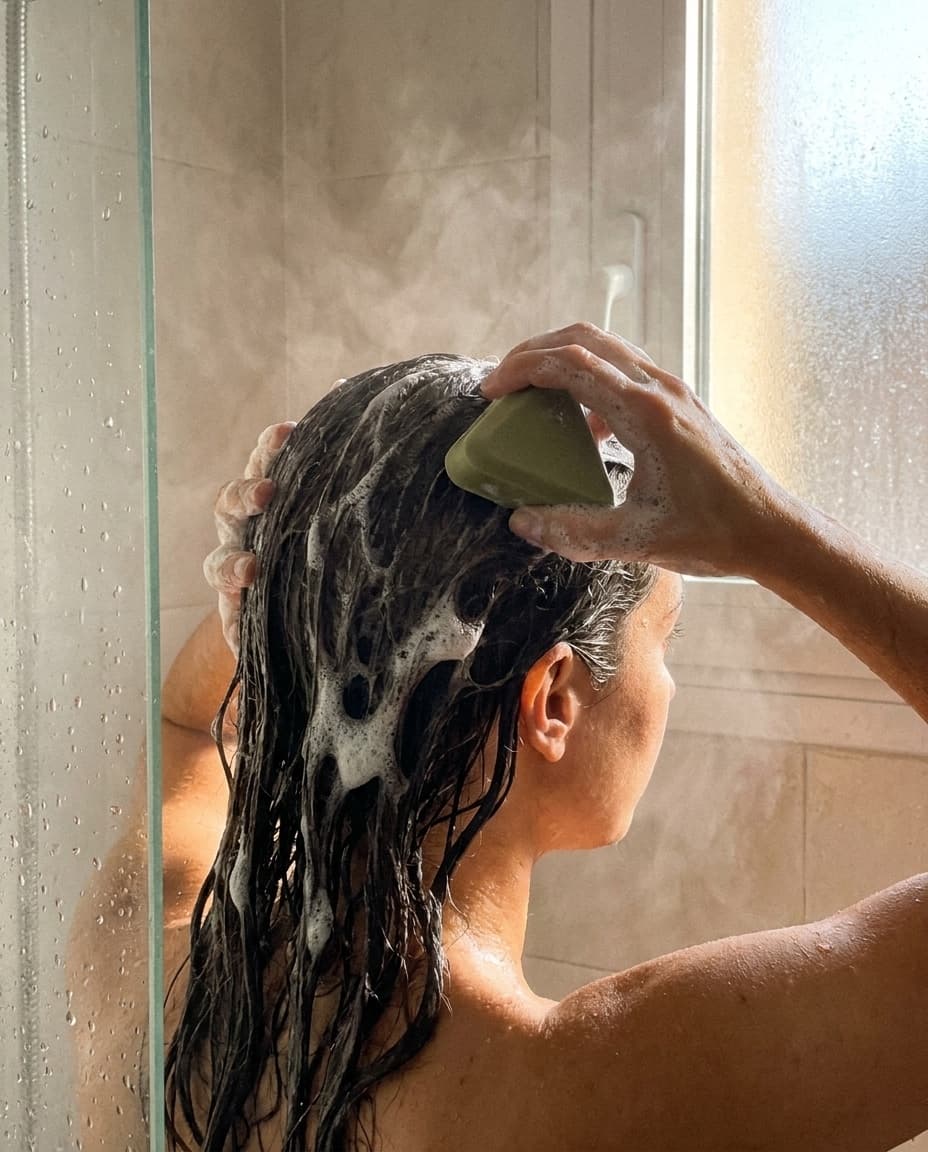
A few washes into a shampoo bar, hair often feels waxy, heavy or straw-like at the roots. That is the shampoo bar transition period, and for most people it runs somewhere between one and four weeks. It is not your scalp “detoxing” — that phrase gets used a lot and means nothing chemically. Two concrete and fixable things are behind it: silicone and conditioning residue left over from your old shampoo, and mineral deposits from hard water reacting with a soap-based bar.
Below: how to tell the two apart, how long each takes to clear, the specific changes that shorten it, and when the problem is not the transition at all.
What is the shampoo bar transition period?
The transition period is the stretch of washes after switching from liquid shampoo to a solid bar during which hair feels different — usually waxier, heavier or more tangled near the roots — before it settles. It typically lasts one to four weeks, or roughly 4 to 12 washes. The change is happening on the hair surface, not inside the strand: you are removing one coating and not replacing it with another.
Conventional shampoos and conditioners deposit silicones (look for ingredients ending in-cone, -conol or -siloxane, such as dimethicone) and cationic conditioning agents that cling to hair. They make hair feel slippery immediately and they build up over months. A sulfate-free bar cleans differently and deposits nothing to replace that film, so for a few washes your hair feels like what it actually is, minus the coating it has worn for years.
One popular claim deserves a caveat: the idea that your scalp “rebalances” and stops overproducing oil after a few weeks of gentler washing is repeated everywhere but is poorly supported by evidence. Sebum output is driven largely by hormones and genetics. What demonstrably changes is what sits on top of the hair and scalp — and that is enough to change how your hair looks and feels.
Why does hair feel waxy after switching to a shampoo bar?
Waxy hair after switching almost always comes from one of two sources. Either silicone residue is loosening unevenly and redepositing along the strand, or you live in a hard-water area and calcium and magnesium ions are reacting with a soap-based bar to form an insoluble film — the same soap scum that leaves a ring on a bathtub. The first clears on its own; the second will not, because your water does not change.
You can usually tell them apart in one wash:
- Silicone residue feels gummy or coated, is worst in the first 2–6 washes, and improves steadily each time. It is concentrated where you used the most product: mid-lengths and ends.
- Hard-water film feels chalky, dull and squeaky-then-sticky, does not improve week after week, and is worst near the roots. Lather is poor and disappears fast no matter how much bar you use.
A third, more boring cause accounts for a large share of complaints: under-rinsing. A solid bar concentrates the formula, so the same visual amount of product is far more product than you are used to. Rinsing for 30 seconds when the job needs 60–90 leaves loosened residue to settle back on the hair as it dries.
How long does the shampoo bar transition period last?
For most people it is one to four weeks. Expect the short end — under two weeks — if you have short or fine hair, used few styling products and live in a soft-water area. Expect four to eight weeks if you have long, thick or curly hair, used silicone-heavy conditioners, masks or heat protectants daily, or wash in hard water. Frequency matters more than calendar days: the clock is measured in washes, so someone washing twice a week takes twice as long as someone washing daily.
A useful reference point for the second question people ask — how long before I judge my hair? — is that hair grows roughly one centimetre, a little under half an inch, per month. Nothing you wash with changes the hair that already exists, only what coats it. So judge a bar on how your scalp and roots feel after 3–4 weeks, not on your ends.
Is hard water making it worse, and how do I check?
Hard water contains dissolved calcium and magnesium, which bind with soap-based cleansers and form an insoluble residue instead of lather. It is the single most common reason a shampoo bar never stops feeling waxy. You do not have to guess: water utilities publish hardness by postcode or ZIP code, usually in mg/L of calcium carbonate or in grains per gallon, and the figure is free to look up.
Rough geography, because it explains a lot of the complaints:
- UK: much of the south and east of England, including London, is hard or very hard; Scotland, Wales and the north-west are mostly soft.
- US: USGS hardness mapping shows hard to very hard supply across most of the Midwest, Texas and the Southwest; the Pacific Northwest and New England are largely soft.
- Canada: the Prairies — Calgary, Regina, Winnipeg — are notably hard; Vancouver and much of the Atlantic coast are soft.
- Australia: Melbourne’s supply is famously soft, while Adelaide and parts of Perth are considerably harder.
Household clues point the same way: limescale on the kettle, spots on glassware out of the dishwasher, soap that will not lather at the basin. If two or three of those are true, treat hard water as the working explanation and go straight to the fixes below rather than waiting out a transition that will not end.
How do you shorten the transition period?
Three things do almost all the work: clear the old residue once with a clarifying wash before you start, change your technique so less product goes further, and use an acidic rinse if you are in a hard-water area. Done together they typically cut the rough patch to a handful of washes rather than a month.
- Clarify once, before your first bar wash. A clarifying or anti-residue shampoo strips accumulated silicone in a single wash. This is the highest-leverage step and the one most people skip. It does not undo your switch; it gives the bar a clean surface to work on.
- Soak the hair properly. 30–60 seconds under warm running water until it is genuinely dripping, not just damp. Dry patches are where uneven deposits form.
- Use less bar, and work it in. Two or three passes over the scalp, or lather in your palms first and apply the foam. In hard water especially, more bar produces more residue, not more lather.
- Massage with your fingertips for about a minute. Circles, no nails. The mechanical part of cleaning matters more with a concentrated product than with a foaming liquid.
- Rinse for longer than feels necessary. Aim for 60–90 seconds until hair squeaks slightly between your fingers at the roots.
- Add an acidic rinse if the water is hard. A commonly used dilution is one tablespoon of apple cider vinegar in 500 ml of water, poured over the hair after rinsing and then rinsed out. The acid dissolves the mineral film. Once or twice a week is plenty; the smell disappears as hair dries.
- Conditioner from mid-lengths to ends only. Never at the roots. This is the most common reason roots feel heavy again two days later.
Am I using the bar wrong?
Probably, in one of three specific ways. Most transition complaints trace back to rubbing the bar along the lengths instead of the scalp, using far too much of it, or storing it in a puddle. A solid bar is applied to the roots — the only part of your head that produces oil — and the lengths get cleaned by the lather rinsing down — the same logic behind the Korean scalp care routine.
Storage is not a detail. A bar left in standing water softens and turns to slime within weeks, and slimy bars deposit unevenly. Keep it on a draining dish out of the shower’s direct spray so it dries between washes.
How do I know it is not the transition period at all?
If eight weeks and a dozen-plus washes have passed with a clarifying wash and an acidic rinse already tried, and hair still feels coated, it is not a transition — it is a mismatch between that specific bar and your water or hair. Soap-based bars struggle most in hard water; syndet-style bars, which use synthetic cleansers rather than saponified oils, are far less reactive to calcium and magnesium and are the sensible next thing to try.
Also separate texture problems from skin problems. Waxiness is a coating issue. Persistent flaking, itching, redness or sore patches are a scalp condition, and no cleanser choice fixes those — if that is what you are seeing, start with telling scalp buildup and dandruff apart, and see a GP or dermatologist if symptoms persist.
Frequently asked questions about the transition period
Do I need an apple cider vinegar rinse forever?
Only if your water is hard. In soft-water areas most people stop after the first few washes and notice nothing. In hard-water areas it is easier to think of it as a permanent part of the routine, once or twice a week, in the same way you would descale a kettle.
Will a clarifying shampoo undo the switch?
No. It is a one-off reset that removes the silicone layer the bar cannot dissolve on its own. Using it once at the start shortens the transition; using it weekly afterwards is unnecessary and can leave the scalp feeling tight.
My hair got greasier rather than waxier — is that the same thing?
Not quite. Greasy roots within a day or two usually mean the scalp is not being cleaned thoroughly enough: too little massage time, too short a rinse, or conditioner reaching the roots. Try a short second wash on the same day — one quick pass, one minute of massage, a long rinse — rather than more product on a single pass.
Can I keep using my normal conditioner during the transition?
Yes, on mid-lengths and ends. If it contains silicones you may extend the waxy phase slightly, since you keep re-depositing the thing you are trying to clear, but detangling matters and going without does more harm to long hair than a slightly longer transition does.
Is the transition worse for curly or colour-treated hair?
Usually longer rather than worse. Curly and coily hair carries more product by volume and sebum travels down the strand less easily, so there is more to clear. The practical adjustments are the same: clarify first, rinse longer, condition the ends generously, and judge the scalp rather than the ends after four weeks.
Sigue leyendo
Scalp Buildup vs Dandruff: How to Tell Which One You Have
Waxy yellow flakes near the hairline and small white flakes across the crown are two different problems. Here is the at-home test that separates them.
Korean Scalp Care Routine for an Oily Scalp: The Steps That Matter
Treat the roots like facial skin: cleanse in two short passes, massage, keep conditioner off the scalp. The method, minus the ten-step mythology.